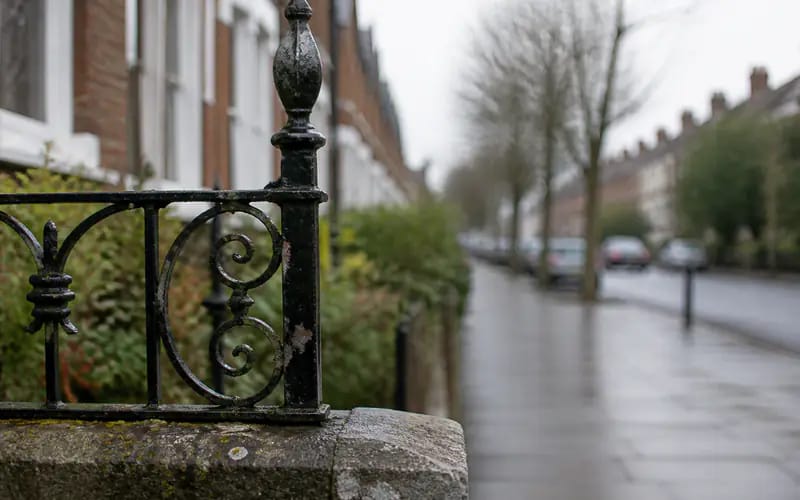
If a section of your railings appears to be OK from ground level, then it can collapse suddenly and severely. You will need to weigh up the cost of patching up again against the cost of replacing the whole section as a single new item, bearing in mind the cost of a call-out for each repair.
Check For Pitting, Not Just Flaking
Surface rust, flaking off in scales or “fingers” looks dreadful but can often be cleaned up with wire brushes to expose smooth metal underneath, which can then be coated to preserve it. Pitting, however, is a different matter. Pits, even shallow ones, can be left but it is generally best to assume that deep or widespread ones have reduced the cross section of the metal and will continue to deteriorate. Thus posts with numerous pits of any depth are best replaced. Small holes, which can be penetrated by a pencil, also indicate that a post is structurally unsound and must be replaced.
Look Below Ground Level
The point where the upright passes into the brick or stone work is typically where wrought iron fails first as this area retains a lot of moisture and never really dries out. Remove some of the surrounding mortar or soil and look for the bottom of the upright to see if it has reduced in size. Also look for any signs of rusting of the iron and see if this is crumbling in your hand. The following Historic England article explains how corrosion typically spreads from fixing points on older ironwork installations.
Count The Old Repairs
One or two repairs on a long run of railing is normal wear and tear. However, if a post has three or more repairs of any type on it, then each subsequent repair is going to have less time to last than the last. Most of the time people are not anymore maintaining a railing, they are maintaining the repairs to it. Therefore it is best to work out the cost of continued repairs against the cost of new railing.
Spot Mismatched Metal And Old Botches
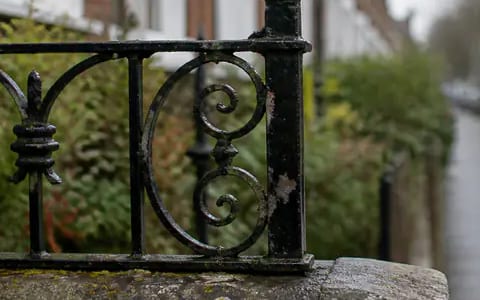
Mismatched metals such as lighter grey steel patch repairs within darker wrought iron can often reveal substandard previous repairs which deteriorate at differing rates. Old botches and amendments to damaged sections such as the use of a scaffold clip to tie together a broken wrought iron bar or scrappy attempts to smother cracks with builders filler and then rub smooth may have provided temporary solutions in the past, but they rarely provide any strong, lasting solution to damaged wrought iron sections. These types of amendments are worth considering when determining whether to adopt a policy of minimal intervention on older sections of ironwork.
Do The Wobble Test
Shake a post. Gripping it near the top of the post give it a good shake from side to side and try to lift it slightly. A good solid post won’t move much at all. Some wobble, some grinding or even some movement upwards and downards can indicate that the fixing into the stone, brick or concrete has begun to corrode or that the masonry around the post has started to crack. This sort of movement in a few of the posts along a run of dozen or so would suggest a repair job is in order. However, if most of the posts are affected in this way then it is likely that a complete replacement of the railings will be required.
Weigh Patch Repairs Against A Full Replacement
The cost of a single repair will often be less than that of a full replacement. But when you add up all the call-outs on top of the cost of materials over a period of 10-15 years it can be cheaper in the long run to have the railings completely replaced. A single post can cost a lot to repair and when it does finally give way it can do so unexpectedly, perhaps with someone leaning against it. It’s also worth remembering that when you do replace your railings the new work can include a full coating and a warranty.
Think About Whether The Design Still Suits The House
Your old wrought iron railings may have been repaired many times and now just look unsuitable for your house. If so, you can look at different types of garden boundary and railing, and choose the most suitable. It’s also wise to check if planning is required for your new boundary features such as height, location and whether you are in a conservation area.
Wrought Iron Railings is covered in more detail at Donkeywell Forge.
A lot can be discovered about railings within a quarter of an hour using a wire brush and some pressure on the posts. The results may surprise you in revealing whether you are in the process of repair or replacement.