
Sliding vs Hinged Replacement Wardrobe Doors
Both hinged and sliding replacement wardrobe doors can be supplied to fit a variety of rooms. The main difference with the two styles is the way in which they behave once fitted in a particular room. It is therefore worth establishing the requirements of your room prior to choosing between the two styles.
Floor Space And Swing Clearance
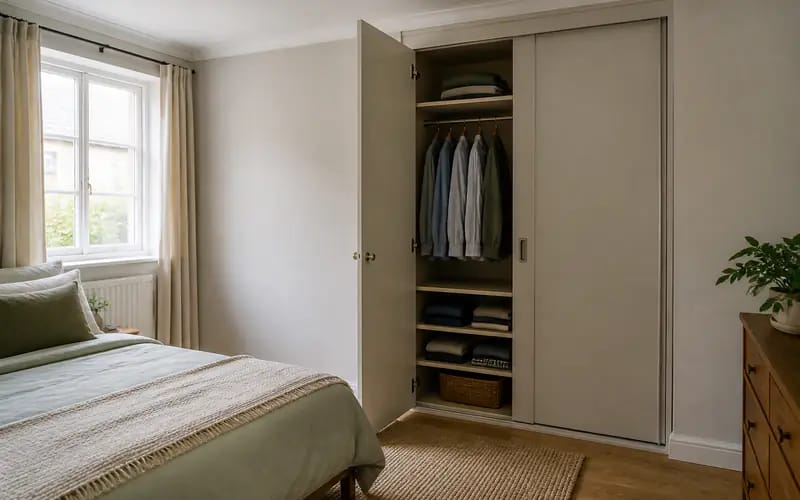
A hinged door needs space to open fully in the room. This space is bigger than you might think. A normal wardrobe door is 600mm wide. When fully open, the door swings in an arc of about 650mm to 700mm in front of the wardrobe. This arc needs to be clear of any objects such as beds, chests of clothes etc. Sliding wardrobe doors do not need this space as they open along tracks within the wardrobe framework. Therefore, sliding doors are ideal for small rooms with limited space as they do not restrict any floor space.
Seeing And Reaching Inside
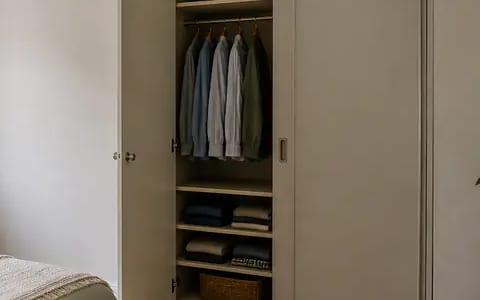
However, a fully opened hinged wardrobe door allows full access to the interior of the wardrobe. A fully opened sliding wardrobe door does not allow full access to the interior of the wardrobe. One panel of the sliding wardrobe door will always obscure part of the rail or shelving at the back of the wardrobe. This can cause some inconvenience when trying to retrieve items stored at the back of the wardrobe. This could mean having to ‘shuffle’ items along the wardrobe to try and access the items at the back.
Child Safety And Trapped Fingers
Young children often close doors by accident and can very quickly have their fingers trapped by a swinging door edge. This is a particular problem with very heavy hinged doors where there is a lot of force involved. Sliding wardrobe doors do not have a door edge that can cause problems, as the door is a flat panel sliding along a track. There is some general guidance on preventing finger-trap injuries in the home that applies to all room doors, but particularly to wardrobe doors with children in the house.
Track And Fixing Considerations
Sliding doors are generally fitted with a top-hung track (where the weight of the door is supported by rollers attached to the top of the frame) or bottom-rolling track (where the door runs along a channel in the floor). Top-hung is generally the best option for carpets as the bottom-rolling track can get clogged with fluff and can be problematic on uneven floors. Hinged doors are not affected by the floor in the same way and ordinary hinges are fixed to the side of the carcass. The whole carcass must be level for the doors to close properly.
Mirror And Panel Choices
Mirrored panels are a classic feature to include in sliding wardrobe doors. A full length mirror in a single sliding panel looks very impressive and does not have a handle in the way of opening and closing, nor does it require clearance space to open inwards. Panelled, shaker style or painted doors are generally better suited to be used on hinged wardrobe doors. This is because you can specify different door widths, include door mouldings to match the surrounding joinery and fit traditional style handles or even knobs.
Which Rooms Suit Which Style
For box rooms, small rooms, rooms with awkward corners or long thin rooms such as some hallways sliding doors are often better than hinged. Larger bedrooms with plenty of space between beds and other furniture can have hinged doors which look very nice and offer better access to the back of the wardrobe. Rooms with wardrobes located in the corner of a room or against the edge of a bed are best measured for swing clearance before deciding between hinged or sliding doors.
Long Term Upkeep And Cost
Hinged doors will occasionally need to be adjusted by means of a loose screw which needs to be tightened. Sometimes a door will have dropped slightly and needs to be realigned. All of this can be done in about five minutes with a screwdriver. Sliding doors have tracks which need to be kept clear of dust, hair and grit as these can cause a sliding door to stick/jump on the track.
Either will make good wardrobes. The main thing to consider is how you intend to use your wardrobe and to measure the actual floor space available, not just relying on drawings to determine which will be best.


