
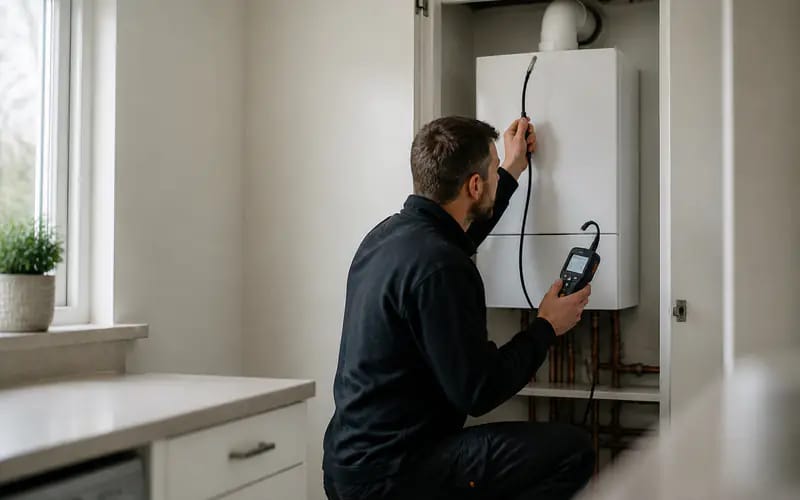
Carbon monoxide testing is one of the most important tests that are carried out during a boiler service. Unfortunately many people do not understand what is being tested and therefore it is often misunderstood by homeowners. This article explains what is actually being tested and why it is more important than most other parts of the boiler service.
What The Gas Analyser Measures
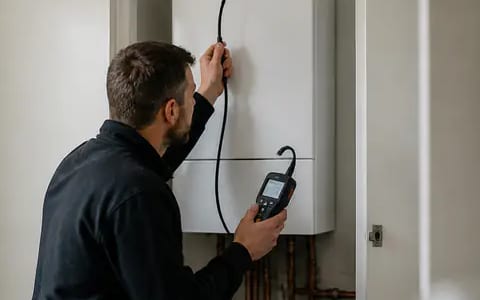
An engineer will use a flue gas analyzer (FGA) to take readings of the flue gases coming out of your boiler. A FGA is a small handheld piece of equipment that has a probe that can be inserted into your boiler flue. The analyzer reads the amount of Carbon Monoxide (CO) and Carbon Dioxide (CO2) in the flue gases. It also works out the CO to CO2 ratio. A good combustion engine (such as a boiler) will have a low reading of CO (close to zero) with a maximum of 50ppm. The CO to CO2 ratio should also be less than 0.004.
Checking The Flue And Ventilation Too
Many people believe that a carbon monoxide test is solely for the boiler but in reality the test also checks the flue and ventilation after the boiler. The flue must be able to safely expel all of the exhaust gases from the boiler and the room must have sufficient ventilation to allow the boiler to draw in sufficient fresh air for combustion. Blockage of air vents, bird’s nests in external flue terminals and even sealed rooms due to building works can all cause problems with carbon monoxide detection even though the boiler itself may be OK.
Testing The Flue With A Spillage Test
A spillage test may also be carried out to check for sufficient draught in the flue. This involves holding a smoke match near the draught diverter whilst operating the boiler. If the smoke is drawn up the flue, then all is well. However, if the smoke spills back into the room then there is a problem with the flue and it will require further investigation before it is agreed that the boiler can be left to operate safely.
Visual Warning Signs On The Casing
The visual parts of the boiler service look for signs of sooting or dark staining on the casing. Scorch marks or any sign of local overheating are also considered to be of concern. Yellow flames or sooty fires are typical indications of incomplete combustion. Many of these problems develop over a long period of time and can be detected before they cause any problems by a trained service engineer.
Why Alarms Alone Aren’t Enough
An alarm is also required to be fitted to detect Carbon Monoxide. It should be placed on a wall at head height and near to the appliance but in a room that is used for sleeping. The alarm should only sound when there is a dangerous level of Carbon Monoxide in the air and does not detect a poorly performing appliance until it has started to produce dangerous levels of the gas. For this reason a Carbon Monoxide alarm should not be used as an alternative to the proper servicing of your boiler and should be used in conjunction with it. It is recommended that Carbon Monoxide alarms are sited at approximately 1-2 meters from the appliance and on a wall at head height. RoSPA (The Royal Society for the Prevention of Accidents) provide information on the risks of carbon monoxide in the home and how it is often referred to as the silent killer as it has no smell, colour or taste.
What Paperwork Should Follow
The engineer should provide you with a record of the test which will include the actual reading of the CO taken. This is important evidence for Landlords who have to complete a Gas Safety Record but it is also important for homeowners so that they have some idea of the previous years reading and can spot any deterioration from one year’s test to the next. It’s worth remembering that even if a boiler seems to be working well between services, there could be hidden problems. A simple annual test could prevent hidden dangers from developing into major problems. See HPR Services for a full service record which includes explanation of readings.
Older Boilers And Hidden Risk
Your boiler can be perfectly working, heating your home without problems, yet silently pumping out lethal amounts of carbon monoxide. This is more commonly associated with older boilers, suffering from worn, cracked heat exchangers or flue deterioration. When components wear, they tend to do so at different rates and so need to be checked annually regardless of previous satisfactory operation. A simple blockage in the flue, a damaged heat exchanger or a blocked flue way can drastically increase the CO produced by your boiler.
Why This Test Shouldn’t Be Skipped
Many people believe that the main reason for a boiler service Cheltenham is to prevent future breakdowns and to ensure that the boiler is functioning properly to heat the property. However, a major part of a full boiler service is the safety test to check for carbon monoxide (CO) combustion problems. The test is done with instruments as these problems can develop slowly and often without warning. For this reason a boiler that appears to be functioning properly could potentially be producing dangerous amounts of CO while burning gas.
By completing the flue gas reading, spillage test and a visual check of the boiler for signs of mis-use or malfunction, you can be confident that your boiler is safely burning gas to heat your home.


