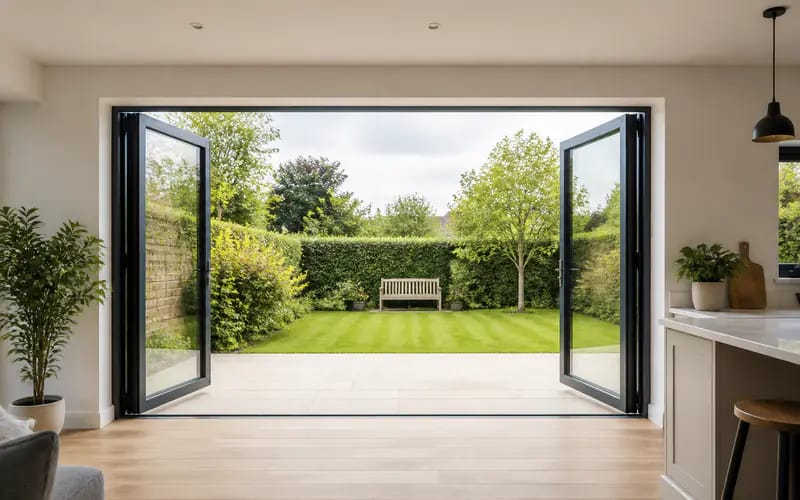
Bifolds and sliding doors are both used for opening up walls to gardens but in very different ways. This means there are a number of ways that bifolds and sliding doors can be better for certain situations than the other.
How Each Door Actually Opens
Bifolds are made of a number of panels which are all hinged together and fold up in a concertina fashion to stack to one side of the opening. Sliding doors have fewer panels but larger ones, which slide along tracks. Generally, one panel will be fixed and the other will slide in front or behind it.
Floor Space And How The Room Flows
The depth of the side wall where bifolds fold back is critical. You need to check for obstructions such as radiators, worktops and light switches within the wall. Sliders are generally a flatter profile to the wall which makes them ideal if you want to make best use of all your wall space. In addition, bifolds create very wide openings that are ideal for bigger parties or just to let in lots of fresh air during the summer months. Clean looking sliders are generally easier to use.
Glass Size And The View Outside
A sliding door usually offers the largest single pane of glass, with fewer lines than bifolding doors. The many hinges, seals and other components of bifolding doors create many more lines than a single large pane of glass. Although both types of doors can provide wonderful views, a sliding door can offer a single large picture window effect whilst bifolding doors offer greater flexibility by being able to fold back to create a large opening.
Thresholds And Keeping The Weather Out
Most styles of bifold doors can be supplied with a low-level threshold for accessibility. Some bifold doors have a lower threshold than others, and it is worth checking how many seal lines there are on a bifold door and how they are maintained. Sliding doors have a higher, more substantial track to support the weight of the panel(s) and to provide weatherproofing against wind driven rain. The track needs to be kept clear of debris such as leaves and grit, and the rollers need to be checked annually for wear. See also Bifold Doors Cardiff.
Heat Loss And Energy Ratings
While a well-made bifold door and a well-made slider can have similar U-values (indicating similar amounts of heat loss) to compare products it is worth understanding how the window and door energy ratings have been worked out. Bifolds have more joints in the frame between the panels, with each joint requiring a good compression seal. Sliders have fewer but larger seals which need to remain uncreased and un-worn to perform well.
Looking After Bifolds And Sliders
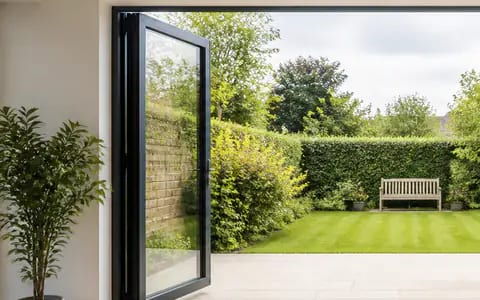
A sliding door track will need to be cleared of grit and leaves on occasion to stop the door becoming stiff and noisy. This is best done with a vacuum and then wiped down with a soft cloth on occasion to remove any wear on the seals. A bifold door has more moving parts than a sliding door and so the hinges, rollers and lockpoints will all benefit from a light lubricator being applied a couple of times a year. Also make sure that all of the panels are closing square to each other and not catching on each other.
Cost And Lead Times To Expect
Sliding doors with 2-3 large panels are generally quicker to manufacture and install than bifolding doors with 5-6 panels. The number of hinges, seals and points of adjustment for bifolding doors can affect the cost of the product and the time it takes to install. A simple 2-panel sliding door could cost less than a similar width bifold configuration, depending on the glass size and type and the material of the frames.
Matching The Mechanism To The Opening
For smaller openings, such as less than 3m wide, Sliding Doors are generally more suitable as they require fewer panels to open up a small space. In addition to requiring fewer panels, Sliding Doors also provide a much flatter profile when in the closed position, making them ideal for smaller wall spaces. For very wide openings, i.e. 4m +, Bifolding Doors are generally more suitable as they allow the opening to be divided into a number of sections, thus avoiding the need for very large individual sliding panels, which can be extremely heavy.
As with any door, the fitting of a bifold or sliding door is just as important as the product itself, so make sure you get the opening measured out correctly and check the seals before installation.