Key Takeaways
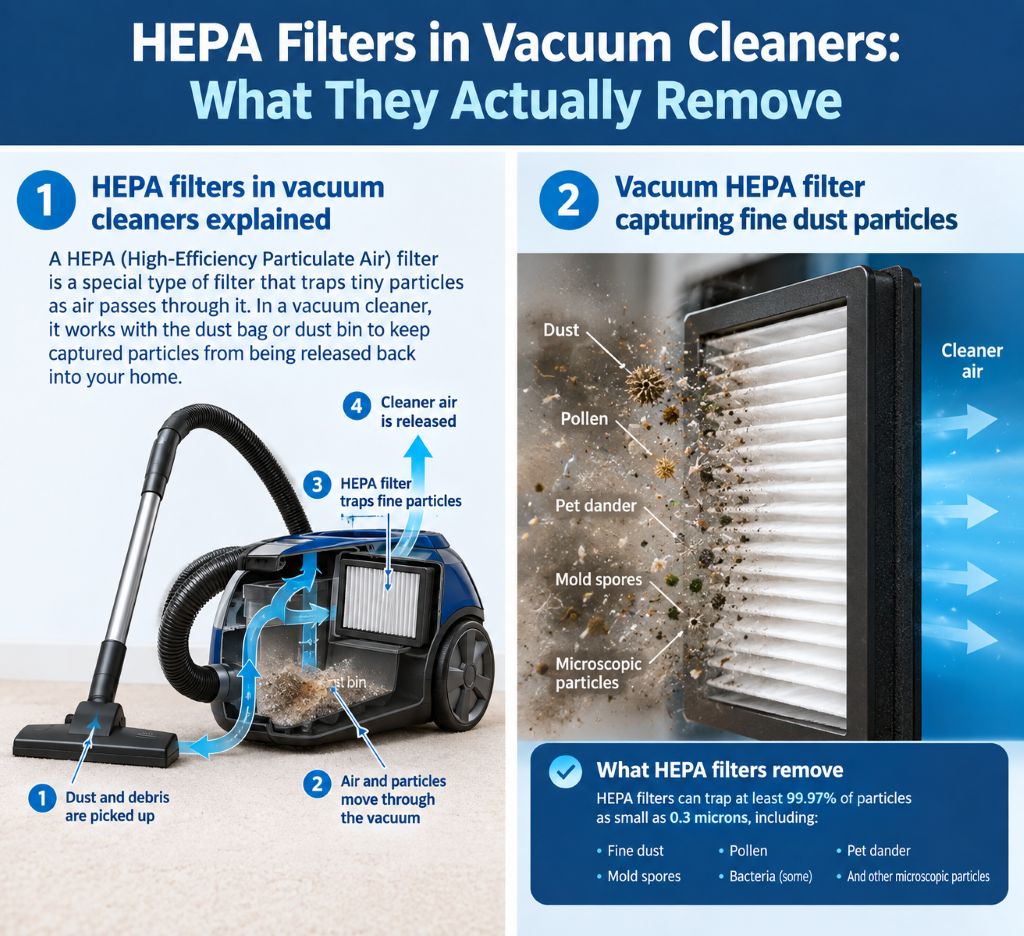
- A true HEPA filter captures at least 99.97 percent of particles at 0.3 microns.
- HEPA filters remove dust, pollen, pet dander, mold spores, and many bacteria.
- HEPA filters do not remove gases, odors, or chemical vapors.
- The term “HEPA-type” does not guarantee true HEPA performance.
- A sealed vacuum body matters as much as the filter itself.
Many vacuum boxes promise HEPA filtration in bold print. However, few shoppers know what that label really means. As consumer appliance analysts at BestVacuumCleaner.us often warn, widespread marketing claims lead some buyers to expect a HEPA vacuum to clean the entire room’s air or eliminate every smell and germ. This guide explains what HEPA filters actually remove. You will also learn what they cannot do.
What a HEPA Filter Really Is
HEPA stands for high-efficiency particulate air. The U.S. Department of Energy defines the standard. According to the U.S. Environmental Protection Agency, a HEPA filter can remove at least 99.97 percent of dust, pollen, mold, bacteria, and other airborne particles at 0.3 microns.
A micron is one-millionth of a meter. For scale, a human hair is roughly 50 to 70 microns wide. Therefore, a 0.3-micron particle is far too small to see.
The EPA explains why 0.3 microns matters. This size is the most penetrating particle size. In other words, it is the hardest size for a filter to catch. Particles that are larger or smaller are trapped with even higher efficiency. As a result, the 99.97 percent rating is the worst-case result.
HEPA filters are not simple sieves. They use a dense mat of thin, randomly arranged fibers, usually made of fiberglass. Particles get caught in three ways. Large ones slam into fibers because they cannot follow the air around them. Medium ones stick as they brush past a fiber. Tiny ones wander erratically and eventually hit a fiber. Together, these actions trap particles of many sizes.
Vacuum makers use this technology to keep fine dust out of the exhaust. Without it, a vacuum can blow tiny particles back into your room. Therefore, filtration quality matters as much as suction power.
What HEPA Filters Remove
HEPA filters excel at capturing solid and liquid particles. Most common household irritants fall into this group. The list below shows typical examples and rough sizes.
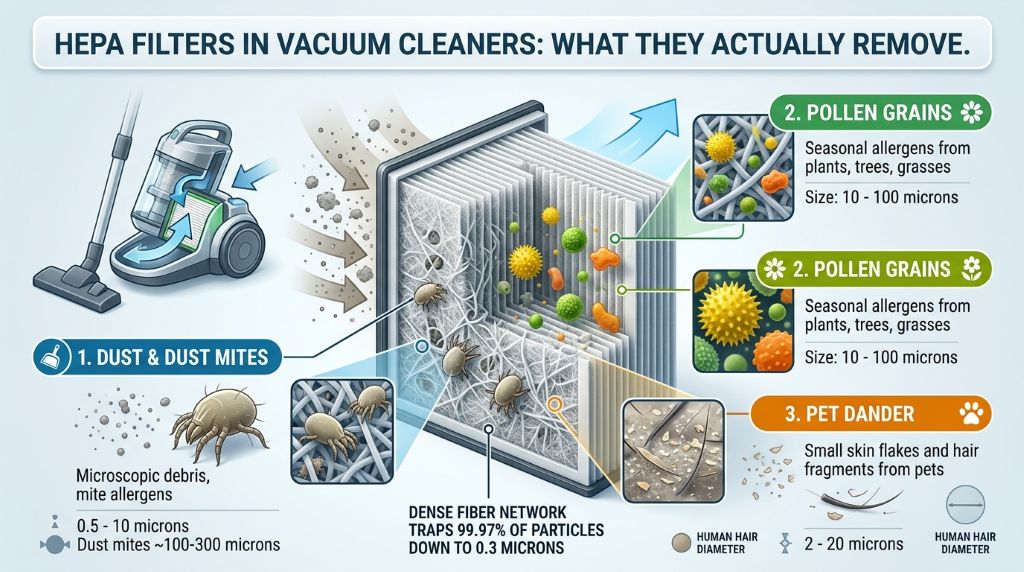
- Pollen: about 10 to 100 microns
- Dust: about 0.5 to 100 microns
- Pet dander: about 0.5 to 100 microns
- Mold spores: about 2 to 20 microns
- Bacteria: about 0.5 to 5 microns
These ranges come from an air-quality guide published by Field Controls. Every item on this list is larger than the 0.3-micron test size. Consequently, a true HEPA filter catches nearly all of them.
Dust mite waste deserves special mention. Mite particles are a major trigger for asthma and allergies. HEPA filtration keeps them from escaping through the vacuum exhaust. This benefit explains why allergy sufferers often look for HEPA models first.
What about viruses? Individual viruses can be very small. However, they usually travel inside larger droplets or attached to other particles. According to Atmotube, these carriers are easier for a HEPA filter to catch. Still, a vacuum is not a medical device. Treat this as a bonus rather than a promise.
Fine particulate matter also matters. PM2.5 refers to particles up to 2.5 microns wide. Smoke residue and combustion dust often fall into this range. A HEPA filter captures the particle portion of these pollutants well.
What HEPA Filters Do Not Remove
HEPA filters have clear limits. Knowing them helps you avoid disappointment. The most important limit involves gases.
HEPA filters do not remove gases, vapors, or odors. Researchers at the University of South Florida state that these filters catch only particulates. Smoke smell, cooking odors, and chemical fumes pass right through. The same is true for volatile organic compounds, often called VOCs.
Some vacuums add a layer of activated carbon. This material absorbs certain odors and vapors. It works alongside the HEPA filter rather than inside it. Therefore, look for a carbon stage if pet or smoke smells bother you.
A HEPA vacuum also does not clean the whole room’s air. It filters only the air that passes through the machine. Airborne dust in a distant corner stays put. Additionally, vacuuming can stir up settled dust before the machine captures it. A dedicated air purifier handles room air better.
Finally, HEPA cannot fix a leaky machine. Air always takes the easiest path. If seals are loose, dirty air slips around the filter. As a result, even a perfect filter loses its value. A sealed system forces all the air through the HEPA layer.
True HEPA vs. HEPA-Type Labels
Marketing language can mislead shoppers. Two labels look similar but mean different things. Understanding the difference protects your money.
True HEPA means the filter meets the 99.97 percent standard at 0.3 microns. Independent testing confirms this rating. Terms like “Certified HEPA” and “Absolute HEPA” describe the same standard, according to Red Vacuums.
HEPA-type, HEPA-like, and “equivalent to HEPA” are different. Filterbuy notes that these are marketing terms and may fall short of the true standard. Therefore, avoid assuming they perform the same.
Use this quick checklist when you shop.
- Look for the words “true HEPA” on the box or product page.
- Confirm the filter meets the 99.97 percent at 0.3 microns standard.
- Check whether the vacuum has a fully sealed system.
- Read the manual to learn if the filter is washable or replaceable.
- Choose models with clear, published test results when possible.
Also consider the whole machine. The best filter still needs strong suction and good seals. Therefore, look at reviews from independent testers, not just the manufacturer’s claims.
Maintaining Your HEPA Filter
A HEPA filter only works well when it stays clean. A clogged filter restricts airflow. Suction drops, and the motor works harder. Regular care prevents both problems.
The EPA advises that all air cleaners need periodic cleaning and filter replacement. Follow your manufacturer’s schedule. Many vacuum HEPA filters need replacing every six to twelve months. Heavy use or pets may shorten that time.
Not every HEPA filter can be washed. Many are made from delicate fibers that break down when wet. Some models do include washable versions. Check your manual before rinsing anything. Washing the wrong filter can ruin it.
Follow these habits to keep performance high.
- Tap or brush loose dust from the filter over a trash bag.
- Replace the filter when it looks gray, matted, or damaged.
- Empty the bin or change the bag before it overfills.
- Dry a washable filter completely before putting it back.
- Keep spare filters at home so you never skip a change.
Additionally, handle used filters outdoors when possible. Fine dust can puff into the air during removal. A quick, careful approach limits your exposure.
Conclusion
HEPA filters do one job very well. They capture fine solid particles such as dust, pollen, pet dander, and mold spores. However, they do not remove gases, odors, or chemical fumes. They also clean only the air that flows through your vacuum. For the best results on hard surfaces, it is equally important to choose the best vacuum cleaner for tile floors without damaging grout, especially when fine debris collects around tile edges and joints.
Choose a true HEPA model with a sealed body for the best results. Keep the filter clean and replace it on schedule. Check the label on your current vacuum today. Then decide whether it is time to upgrade to a true HEPA machine.
Frequently Asked Questions
What does HEPA stand for?
HEPA stands for high-efficiency particulate air. The standard requires 99.97 percent capture at 0.3 microns.
Does a HEPA vacuum remove pet odors?
No, HEPA filters capture particles, not smells. Choose a model with an added activated carbon filter.
Can I wash a vacuum HEPA filter?
Only if the manufacturer says so. Many HEPA filters are not washable and need replacing instead.
Is HEPA-type the same as true HEPA?
No, HEPA-type is a marketing term. It may not meet the 99.97 percent standard.
How often should I replace a HEPA filter?
Most need replacing every six to twelve months. Follow your manual, and replace it sooner if suction drops.